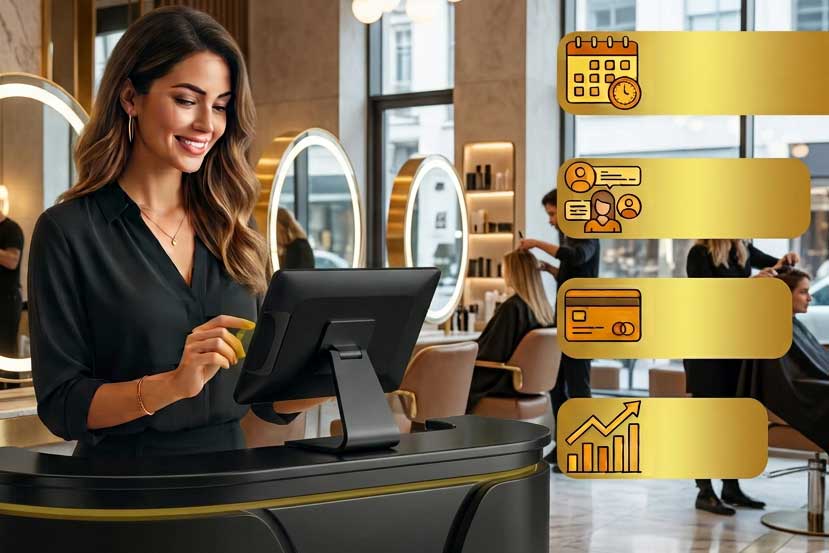

Think about the last time you walked into a retail store and had a genuinely seamlessexperience.
The staff member knew exactly what was in stock. The checkout took less than aminute. You got a digital receipt on your phone. When you asked about a productthat was not on the shelf, they checked availability at another branch — andarranged for it to be reserved — without leaving your side.
That experience did not happen by accident. It happened because that retailer wasrunning a cloud-based POS system.
Now think about the opposite experience — the one most shoppers encounter far moreoften. Staff who cannot find a product on the system. Long queues at a singlefixed counter. A manager disappearing to the back office to check stock. Adisconnected online store showing items that are actually out of stock in thephysical shop.
That experience is the cost of running on outdated retail technology.
In 2026, the gap between these two experiences has never been wider — and thetechnology driving the difference has never been more accessible.
Many retailers are still running their operations on the same point-of-saleinfrastructure they installed a decade ago. Legacy POS systems —server-dependent, location-locked, manually updated — were built for a retailworld that no longer exists.
In 2026, the cloud POS system is not an upgrade. It is a necessity.
It runs on a local server- All the data — sales, inventory, customer records — isstored on a physical computer or server inside the store. If that servercrashes, your data is gone or inaccessible. If you want to check sales fromhome, you cannot.
It is tied to one location- Legacy POS systems werebuilt for one store, one counter. If you open a second store, you need asecond system — and the two systems do not talk to each other automatically.Stock levels, sales data, and pricing have to be manually synced betweenlocations.
It requires IT maintenance- Software updates have to be installed manually, often by an ITtechnician. Security patches, new features, and bug fixes do not happenautomatically. Many retailers run on versions that are years out of datewithout realizing it.
Data is always slightly out of date- Because everything is stored locally and synced manually, the data in alegacy POS is never truly live. You might see yesterday's stock count — nottoday's. You might see last night's sales — not this morning's.
It only works on specific hardware- Legacy POS systemstypically require proprietary hardware — a specific terminal, a specificoperating system, a specific setup. If the hardware breaks, the whole systemgoes down until it is repaired or replaced.
A cloud POS system — or cloud-basedpoint-of-sale system — is retail management software that runs entirely overthe internet, storing all data securely in the cloud rather than on a localserver inside your store.
Unlike traditional legacy POS systemsthat are tied to a single physical location and require dedicated hardware,servers, and IT maintenance, a cloud POS system works on any device — a tablet,a smartphone, a laptop, or a desktop computer — from any location, at any time.
Every sale, every stock movement, everycustomer interaction, and every report is updated and accessible in real time —across every store, every channel, and every device connected to your account.
It is the difference between running yourretail business with a complete, live view of everything happening across yourentire operation — and running it with a fragmented,always-slightly-out-of-date picture that causes errors, wastes time, and costssales.
Every sale, return, and stock movement is reflected instantly acrossevery store, warehouse, and online channel. Your staff always know exactly whatis available and where. Your customers never experience an oversell.
Cloud POS software runs on iOS, Android, Windows, and any modern browser.There is no proprietary hardware to buy, no servers to maintain, and no IT teamrequired to keep it running.
In-store, online, and mobile channels all share a single live inventory.Click & Collect, ship-from-store, and assisted selling across branches areall supported natively — without third-party middleware or custom integrationwork.
Cloud POS systems update automatically in the background. New features,security improvements, and performance updates are deployed without any actionfrom your team — and without any operational disruption.
Start with one store and one device. Add new locations, new staff, newchannels, and new markets without ever changing platforms or migrating data.Cloud POS systems grow with your business — removing the ceiling that legacysystems impose on retail growth.
Theretail landscape of 2026 rewards businesses that operate with speed, accuracy,and complete visibility across every channel and location. Cloud POS systemsmake all three possible — at a scale and cost that is accessible to retailersof every size, from a single boutique to a multi-location chain.
LegacyPOS infrastructure is not just outdated. In a market moving at this pace, it isa competitive disadvantage.
Theretailers writing their best stories right now are the ones who have alreadymade the move.
This is where Stori's specific capabilities are introduced naturally as asolution to everything discussed above.
Theretailers writing their best stories right now are the ones who made thedecision to move.
👉 Get started with Stori today
Your Go-To Hub for Smarter
Subscribe for latest updates

© Copyright 2026 | Stori


.svg)